
Old Burying Ground
Suggested duration: 45 minutes
The History
Halifax's first cemetery was established within days of the city's founding — the first burial took place on June 22, 1749, the day after Governor Edward Cornwallis and the first settlers arrived. For nearly a century it was the city's principal burial ground. Roughly 12,000 people are buried here, though only about 1,200 headstones survive. The last burial was in 1844, and today it's a National Historic Site (1991) — one of the few preserved 18th-century graveyards in North America.
The winter of 1749–1750 nearly overwhelmed it: a typhoid epidemic killed more than 1,000 early settlers in a single winter, forcing the cemetery to expand from one acre to over two. Gravediggers worked through frozen ground to keep up.
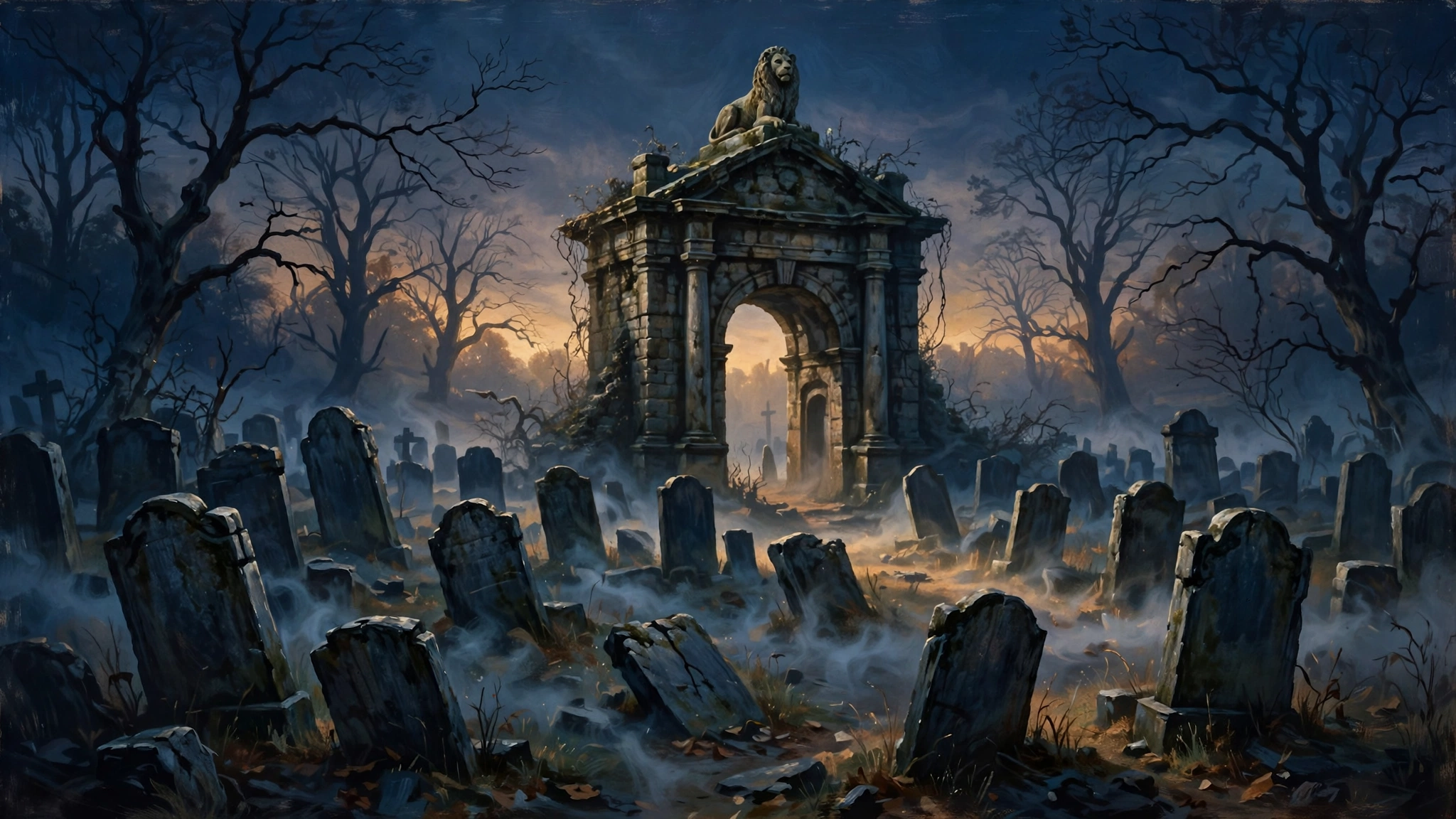
The stones themselves are a museum. Look for winged skulls and soul effigies (winged faces) — 18th-century symbols of the soul's flight to heaven — along with urns, willows, and inscriptions like "Remember me as you pass by. As you are now, so once was I." The beautiful "Adam & Eve" stone, carved by James Hay in 1775 for Mary Bulkeley, is considered one of the finest examples of early gravestone art in Canada.
Notable residents: Major-General Robert Ross, the British commander whose troops burned Washington in the War of 1812 (buried here with full military honors); Shakespearean actor William Paget; and Mi'kmaw Chief Francis. One famous almost-resident: Captain James Lawrence of the USS Chesapeake, killed in the 1813 battle with HMS Shannon, was buried here — but his body was later moved to New York.
Framing the entrance is the Welsford-Parker Monument (1860) — a Roman triumphal arch topped with a British lion, built to commemorate Nova Scotians killed in the Crimean War, including Major Augustus Welsford and Captain William Parker, who died at Sebastopol in 1855.
The Haunting
With 12,000 dead and only 1,200 marked graves, this is a place where the stories practically tell themselves. Local ghost-tour guide Andy Smith has said that he and an entire tour group once watched a male figure materialize about 30 feet ahead of them on the path, cross in front of the group, and vanish. Visitors report shadowy figures between the stones, disembodied whispers, and sudden cold spots.
The most-told legend is that of Elizabeth Crowley, said to have died in childbirth in 1751. The story goes that she walks between the gravestones in period dress, sometimes accompanied by the sound of a crying infant — and that groundskeepers have found fresh flowers on her grave on mornings after the cemetery was locked for the night. Like all good graveyard legends, it's unverified. But it's a fine story to carry with you down the rows.
Walking Route / What to See
Enter at the corner of Barrington Street and Spring Garden Road (free admission; open daily — check posted hours at the gate). Start at the Welsford-Parker Monument at the entrance, then wander the rows slowly — this is a reading cemetery, and the inscriptions reward patience. Seek out the Adam & Eve stone, the winged-skull carvings, and Major-General Ross's grave. The two optional church visits below fit inside your 45 minutes if you move at a good clip; otherwise, give the graveyard the full hour. It deserves it.
⛪ Optional: St. Mary's Basilica
Clearly optional — not a scheduled stop. Visit only if you choose, within your 45 minutes at this stop.
The oldest Roman Catholic church — and the first stone church — in Halifax. The cornerstone was laid on June 29, 1820, and the first Mass was celebrated in November 1829 (it was originally named St. Peter's; renamed St. Mary's in 1833). The Gothic Revival facade and its 189-foot granite spire — the tallest freestanding granite spire in North America — were added in the 1860s–70s. The tower holds 11 bells (1879); several cracked in the 1917 Halifax Explosion and were sent to England to be recast. It survived the Explosion, was elevated to a minor basilica in 1950, and welcomed Pope John Paul II in 1984.
Walking directions: Exit the Old Burying Ground onto Spring Garden Road and turn right (west). The basilica is about a block up on your right — roughly a 2-minute walk.
⛪ Optional: St. Paul's Anglican Church
Clearly optional — not a scheduled stop. Visit only if you choose, within your 45 minutes at this stop.
Founded in 1749 and opened for worship on September 2, 1750, St. Paul's is the oldest surviving Protestant church in Canada and the oldest building in Halifax. Its Georgian design was inspired by St Marylebone Chapel in London, and from 1787 to 1864 it was the first Anglican cathedral outside Great Britain. During the Halifax Explosion of 1917, the church served as an emergency hospital, with the wounded tended in the vestries. It was the only church in the city considered safe enough to hold a service the next day.
Two Explosion relics remain inside: a piece of window frame still embedded in the vestibule wall, and the famous "Explosion Window" — a gallery window that shattered into the silhouette of a man's head and shoulders. The congregation concluded the likeness is that of Rev. Jean-Baptiste Moreau, who arrived with Cornwallis. Whether it was the blast's heat, flying debris, or something stranger that drew that profile is one of Halifax's favorite mysteries — but the shattered window itself is real, and you can stand in front of it.
Walking directions: Exit the Old Burying Ground onto Barrington Street and walk north (uphill) about four blocks to the Grand Parade. The church stands at the south end of the square at 1749 Argyle Street — roughly a 5-minute walk.