
Fairview Lawn Cemetery – Titanic Graves
Suggested duration: 25 minutes
The History
On the night of April 14, 1912, the RMS Titanic struck an iceberg and sank in the early hours of April 15, killing more than 1,500 people. Halifax — the nearest major port to the disaster site — became the center of the recovery operation. The White Star Line chartered cable ships, led by the CS Mackay-Bennett, which recovered 306 bodies from the North Atlantic. (116 were buried at sea when the ship ran out of embalming supplies — first-class passengers were preferentially preserved, a grim triage of the era.)
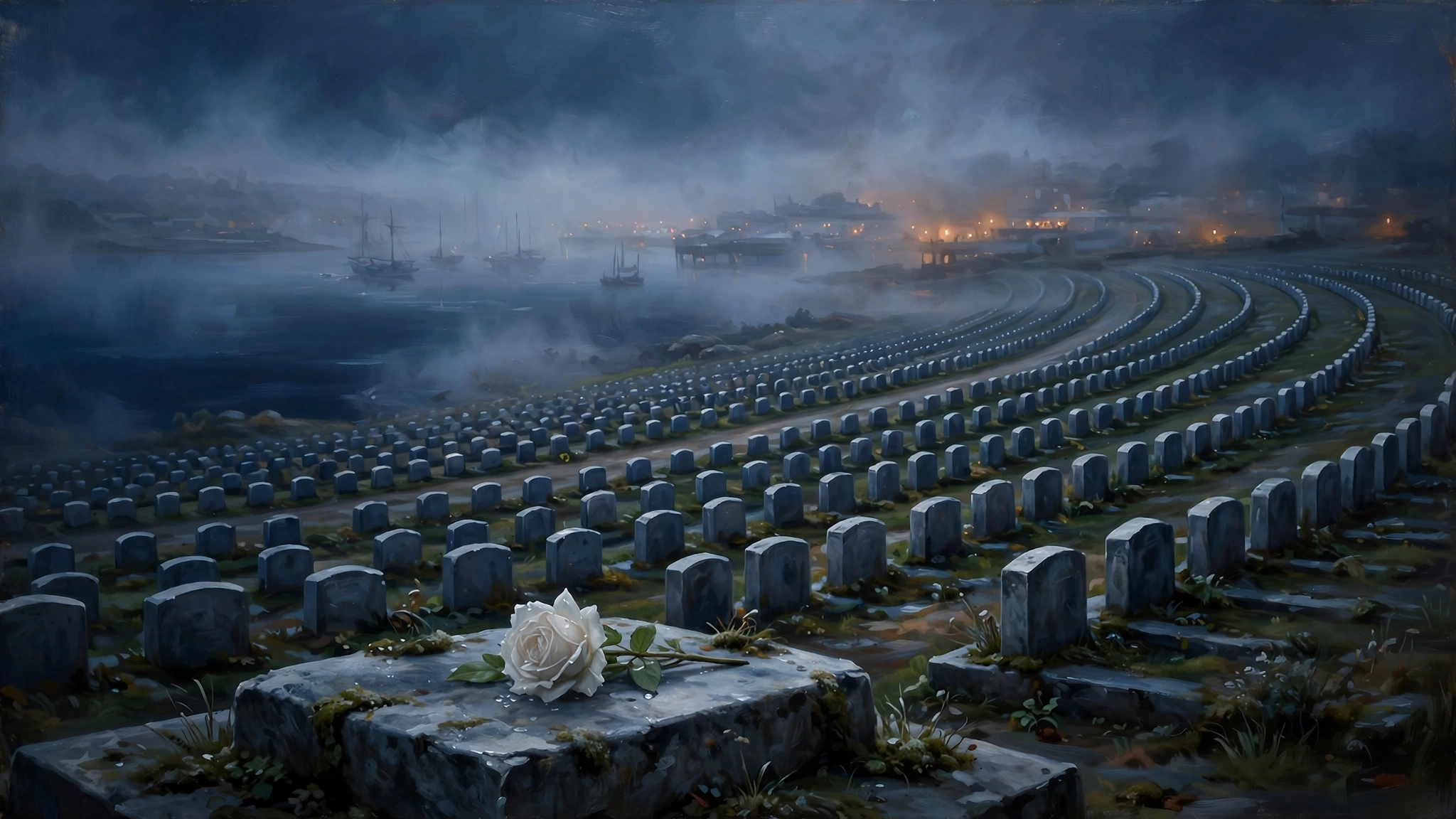
City coroner John Henry Barnstead selected Fairview Lawn for the burials and created a pioneering identification system: numbered sealed bags, catalogued personal effects, photographs of the unidentified. 121 victims are interred here — more than in any other cemetery in the world. (Another 19 rest at Mount Olivet Cemetery and 10 at Baron de Hirsch, for 150 Titanic victims in Halifax altogether.) The White Star Line paid for simple grey granite markers; a third of the dead were never identified, and their stones bear only a date — April 15, 1912 — and a body number. By coincidence, the three long curved rows of graves trace the outline of a ship's bow.
Two graves draw the most visitors. "J. Dawson" (grave 227) is not who you think: research has shown it belongs to Joseph Dawson, an Irish coal trimmer who worked in the ship's boiler room — not the fictional Jack Dawson from the 1997 film. (Director James Cameron has said the character wasn't named for the grave.) After the movie, mourners left flowers and cinema ticket stubs here for years.
The Unknown Child was recovered by the Mackay-Bennett; the crew was so moved that the sailors pooled their own money for his headstone: "Erected to the memory of an unknown child whose remains were recovered after the disaster of the Titanic, April 15, 1912." In 2007, DNA testing finally identified him as Sidney Leslie Goodwin, a 19-month-old English boy — the entire Goodwin family, third-class passengers emigrating to America, died that night. (An earlier 2002 identification as a Finnish child, Eino Panula, proved wrong.)
Note: Fairview also holds a mass grave of victims of the 1917 Halifax Explosion — this cemetery has seen more than its share of history.
The Haunting
No specific ghost stories are documented at Fairview Lawn — and honestly, it doesn't need them. Visitors consistently describe a deep, heavy sorrow settling over the Titanic section. The modern folklore here is the J. Dawson phenomenon itself: for years, grieving strangers left flowers at the grave of a man who never existed, for a love story that never happened — a kind of living legend written in real tears over a real man's real grave. If any place on this tour earns a moment of silence, it's this one.
Walking Route / What to See
Getting there: Fairview Lawn is at 3720 Windsor Street, about 3.5 km northwest of downtown — roughly a 10–15 minute taxi or bus ride. Plan your transport so you have a full 25 minutes on the ground. The Titanic section is clearly signed; walk the curved rows slowly. Prioritize three things: the Unknown Child marker, the J. Dawson stone, and a slow pass down the rows reading the numbered markers of the unidentified. Then rejoin your group — 25 minutes goes fast here.